
The Intelligence Reset: Machine Learning to Machine Unlearning and Relearning
From static models to adaptive reasoning systems—reengineering machine intelligence for volatility, drift, and relevance

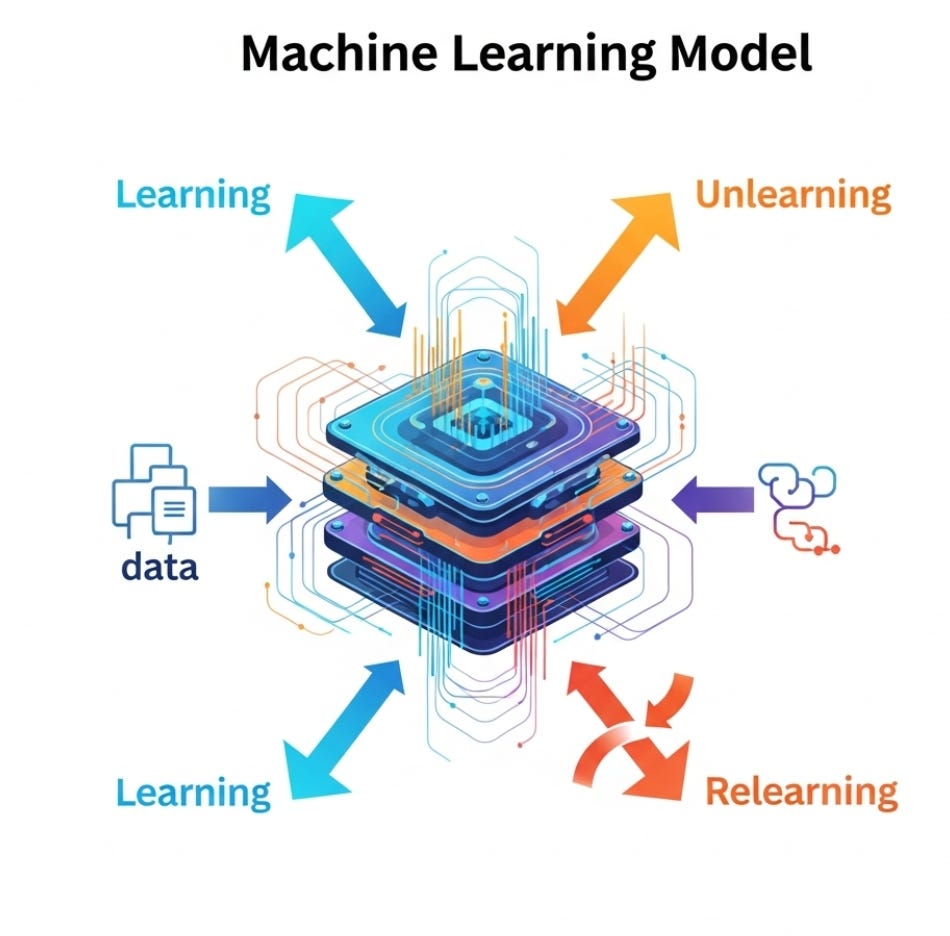
🔍 Five-Part Series Overview
In a world shaped by volatility, hallucination, and accelerating change, the real bottleneck in AI isn’t compute—it’s context.
Today’s AI systems learn. But they don’t forget.
They memorize past patterns. They optimize for historical distributions.
They assume the world is stationary—when in fact, it’s anything but.
But relevance has a half-life. And intelligence is no longer about what you know, but how fast you can unlearn and relearn.
This series introduces a new AI framework for the real world—one designed for constant change:
Systems that know when their knowledge is obsolete
Architectures that replay the past to replan the future
Metrics that track signal decay and reflex responsiveness
Agents that reason not just step by step—but moment by moment
We call this the Machine Relearning Loop.
🏭 Industry Context
In capital markets, alpha dies with delay.
In defense, software must adapt faster than the adversary.
In high-tech manufacturing, QC systems fail when they can’t track sensor drift in real time.
Across all three domains, the root problem is the same:
We designed systems to learn—but not to forget.
Today’s AI pipelines optimize for static benchmarks.
They execute plans based on assumptions that may no longer hold.
And in environments shaped by latency, adversarial dynamics, or microsecond data… static knowledge is fragility.
To survive, AI must:
Relearn in context
Respond in real time
Reflexively adapt as signals decay
This is the Machine Relearning Loop.
And it’s already becoming the edge in markets, battlefields, and factories.
🧱 The 5-Part Series
Part 1: The Intelligence Trap — Why Unlearning Is the First Upgrade
In capital markets, alpha evaporates when models lag behind the macro shift.
In defense, software that can’t forget obsolete strategies loses decisiveness.
In fabs, sensor thresholds age in hours.
This post introduces machine unlearning—not as a compliance checkbox, but as a core engine of performance.
Part 2: Contextual Replay — Testing as if the Mission (or Market) Depends on It
Backtesting assumes the past repeats. But markets mutate.
Defense systems trained on yesterday’s playbooks miss tomorrow’s maneuvers.
Smart factories can’t rely on average-quality thresholds.
Enter Contextual Replay—a simulation-first architecture that tests new logic within real-world context.
This is how AI learns to relearn before failure.
Part 3: Reflex Over Accuracy — The Metrics That Save Seconds (and Billions)
In trading, execution reflex beats predictive power.
In defense, latency kills decisions.
In manufacturing, signal decay leads to invisible defects.
We introduce two new system-level KPIs:
Relevance Half-Life: How fast your model’s insights expire
Reflex Latency: How quickly your system responds to decay
These are the real indicators of intelligent performance in real time.
Part 4: Decay-Aware Performance — Your Next Risk Indicator
Accuracy is yesterday’s KPI.
Today, we track:
How quickly a model drifts
How well it detects its own decay
How safely it transitions under stress
In finance, this prevents PnL cliffs.
In defense, it flags mission risk before failure.
In fabs, it preserves yield against creeping error.
Decay-Aware Performance (DAP) is the risk signal modern AI must expose.
Part 5: Agents That Replan — From Static Playbooks to Temporal Autonomy
LLM agents today can chain thoughts.
Tomorrow’s agents must know when their thoughts go stale.
This post introduces:
Token Half-Life: Decaying memory and ephemeral signal tracking
Reflexive Planning: Automatically replanning as new context emerges
Temporal Reasoning: Moving from procedural logic to situational awareness
These are the capabilities that enable agents to adapt in milliseconds, not quarters.
🔁 Conclusion: The Machine Relearning Loop
The old AI lifecycle—train, deploy, monitor—is no longer viable.
The new loop is:
➤ Learn
➤ Unlearn
➤ Replay
➤ Relearn
➤ Reflex
This is how:
Alpha is retained
Missions are recalibrated
Manufacturing lines avoid catastrophic drift
If your system can’t forget, it can’t adapt. If it can’t adapt, it won’t survive.
This is the Intelligence Reset.
And it’s already underway.
Part 1: The Intelligence Trap — Why Unlearning Is the First Upgrade
“The habits that made you successful will ultimately limit your future.”
— Barry O’Reilly, Unlearn
In 1997, Tom Mitchell defined machine learning as a system that improves performance by learning from experience. For nearly three decades, that definition held. We built models that accumulated more data, more features, more experience—believing that more learning meant more intelligence.
That belief is now a liability.
Across industries—from capital markets to aerospace to high-tech manufacturing—the world has changed faster than our models. Volatility, drift, latency, and adversarial complexity have become the norm. What worked yesterday is no guarantee of survival tomorrow.
And yet, our systems continue to treat old patterns as gospel.
⚠️ The Trap of Accumulated Intelligence
In capital markets, algorithms trained on historical volatility misfire during macro regime shifts.
In defense, autonomous systems repeat tactics long after they’ve been countered.
In semiconductor manufacturing, sensor thresholds calibrated last quarter now trigger false positives or miss subtle failures.
The common denominator?
AI systems that cling to stale assumptions, reinforce historical bias, and fail to recognize when their environment has changed.
This is the intelligence trap—the belief that more experience equals better outcomes. In reality, it's the inability to let go of outdated knowledge that kills performance.
🔄 The Rise of Machine Unlearning
Most people think unlearning is about privacy—removing data to comply with regulations like GDPR.
But in 2024, unlearning has emerged as a performance architecture.
According to the IEEE Machine Unlearning Survey:
“Unlearning enables a model to behave as if specific data had never been seen.”
In practice, this means:
Removing stale or misleading training data
Suppressing features that no longer correlate with desired outcomes
Pruning weights that capture obsolete patterns
Breakthroughs in approximate unlearning, influence functions, and federated retraining have made this possible—efficiently and at scale.
And the reason is urgent: relevance decays.
Your model’s best insight today could become tomorrow’s biggest liability.
🧠 A New Definition of Machine Intelligence
If Mitchell's 1997 definition defined learning as improvement through experience, the 2025 definition must be:
A machine is intelligent if it can unlearn patterns from obsolete contexts and relearn adaptively from its current environment to drive outcomes in real time.
This is not a philosophical upgrade. It’s an operational necessity.
Capital markets change with every macro shift.
Defense conditions evolve minute by minute.
Factory floors operate under continuous micro-variation.
Only systems that relearn can survive.
🔁 The Relearning Loop
Modern AI must operate in a continuous cycle:
PhaseDescriptionLearnAccumulate patterns from real-time or historical dataUnlearnSuppress outdated patterns when they fail or driftReplaySimulate decisions in context using full-environment stateRelearnAdapt with new logic derived from current conditionsReflexDeploy updated responses automatically, ahead of KPI degradation
This loop is already emerging in real-world systems:
Banks that suppress trading signals based on relevance decay
A&D systems that simulate mission scenarios for rapid plan regeneration
Semiconductor fabs that test quality thresholds against context-rich replays
📉 Legacy Pipelines = Blind Spots
Traditional ML stacks were designed for a stable world:
Snapshot-based training on historical warehouse data
Batch retraining on fixed intervals
Evaluation through static backtests or holdout sets
But these pipelines fail in volatile domains. They’re too slow to adapt, too rigid to unlearn, and too disconnected from reality to respond in time.
“Static pipelines reinforce outdated assumptions, particularly in volatile domains.”
— Zhao et al., AI Bias and Drift, 2023
🔍 Real-World Impact
A quant fund loses millions due to a model that can’t adapt to central bank commentary drift.
A battlefield drone ignores updated targeting intelligence because it hasn’t refreshed its strategic heuristics.
A chip yield prediction model flags errors that no longer matter—and misses new failure modes.
In all cases, the failure isn’t just technical.
It’s epistemic—the system is confident in the wrong knowledge.
💡 Core Insight
“The greatest risk in AI isn’t being wrong—it’s being right too slowly.”
In environments where relevance degrades by the second, systems that don’t know how to unlearn become their own failure mode.
📌 Coming in Part 2:
Why contextual replay testing is more powerful than static backtesting
How reflexive systems detect decay before KPIs collapse
Architecting adaptive pipelines for real-time relearning